Scroll down ↓
“A Recurring Pattern”: Civilians Paying the Price in Mali’s Drone Campaign
Sign up here to receive Bellingcat’s biggest investigations by email as soon as they are published.
WARNING: This report contains links to graphic images and footage.
A joint Bellingcat and Jeune Afrique investigation into drone strikes carried out by the Malian military adds new details about the attacks which frequently are carried out in civilian areas and have reportedly resulted in the deaths of civilians.
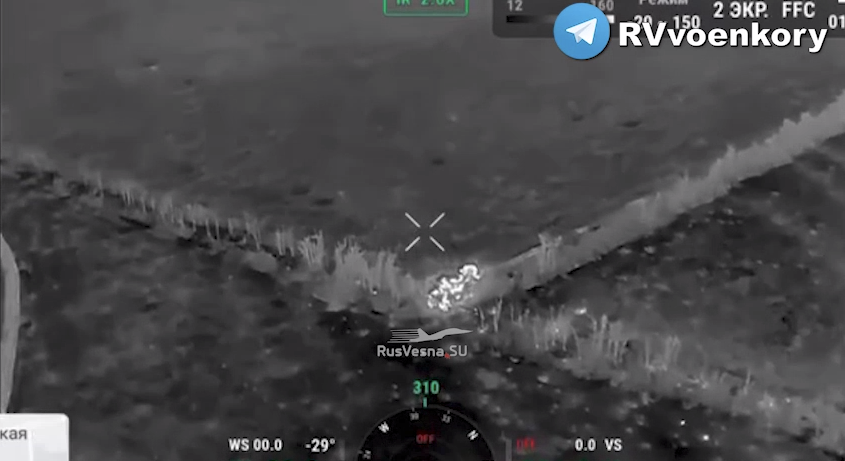
The incidents, concentrated in northern Mali, often involved strikes on vehicles or commercial activity. Video footage of the strikes is often broadcast on national television, portrayed as precise attacks against terrorists and their logistics.
Mali’s military government acquired its first Turkish-made Bayraktar TB2 drones in late 2022, and regularly releases footage of drone strikes to be broadcast on national television, describing them as “precise” and describing the targets as “terrorists and their logistics”. This month marks three years since Mali joined with Burkina Faso and Niger to form the Alliance of Sahel States (AES). Its military government has made restoring national sovereignty a central part of its political message.

Support Bellingcat
Your donations directly contribute to our ability to publish groundbreaking investigations and uncover wrongdoing around the world.
Bellingcat geolocated more than a dozen drone strikes including instances in which civilian deaths and injuries were reported. However, this represents just a fraction of the strikes that have taken place in northern Mali, with many more conducted for which footage was not available or further details were harder to verify as the locations are so remote.
Yvan Guichaoua Senior Researcher at the Bonn International Centre for Conflict Studies told us the Malian military’s drone strikes appeared to fit a pattern of “guilt by location” in which people may be treated as targets based on where they are rather than who they are.
He added that the broadcast of drone strikes on national television, often accompanied by dramatic commentary created a familiar narrative for veiwers that was akin to daily episodes “of a national saga”. Yet the impact of the drone war on civilians and non-combatants is seldom covered in such reports.
Mali’s civil war involves separatist and Islamist groups and has been ongoing since 2012, predating the formation of the AES. But the conflict has spiked in 2026 as Tuareg separatists from the Azawad Liberation Front (FLA) and militants from the al-Qaeda affiliated Jama’at Nusrat al-Islam wal-Muslimin (JNIM) seized control of parts of the country’s north in coordinated attacks against the Malian military and Russia’s Africa Corps forces. The Malian military (known hereafter by their official name Forces Armées Maliennes or FAMa) has relied heavily upon drone strikes in response.
We contacted FAMa and put our findings to them but did not received a substantive response at time of publication.
Destruction in Zouera
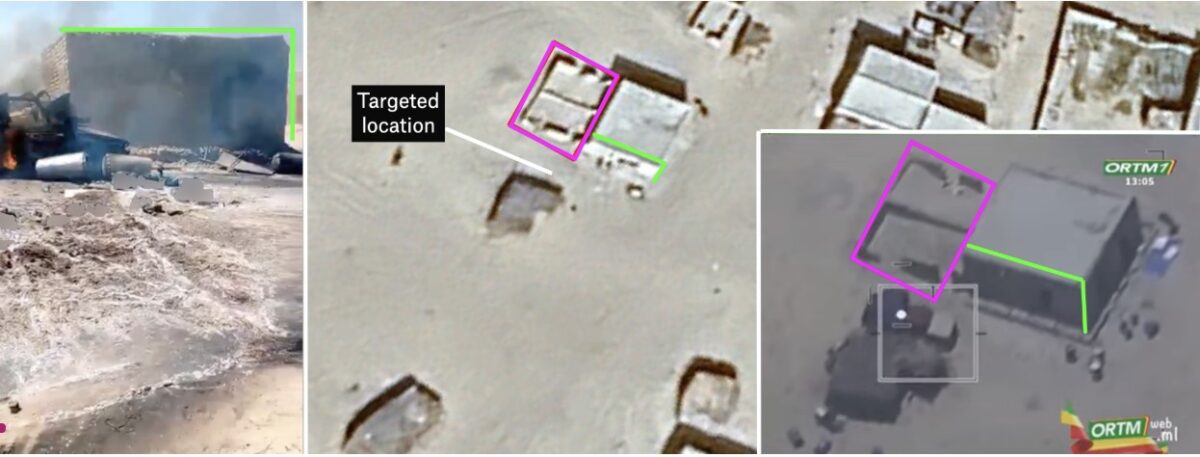
In one notable case – on July 8, 2025 FAMa presented a drone strike in the town of Zouera, in the Timbuktu region, as a successful operation against a supply vehicle for terrorists in footage broadcast on ORTM1 [4:50-5:31]. Drone footage shows a person walking near the vehicle before it is struck. The explosion immediately ignites a nearby structure, while several people can be seen running away.
One video of this incident, apparently showing the aftermath of the attack, shows the remains of a person inside the burnt-down structure, which was located directly beside the vehicle that was hit in the strike. We also checked satellite imagery and found a noticeable burn scar at the location in imagery taken on Jul 9, 2025, that wasn’t visible the previous day.
Bellingcat geolocated the strike site to the coordinates 16.84589, -3.85213, inside Zouera. Several videos filmed in the immediate aftermath show the destroyed vehicle, a large plume of black smoke, and the nearby structure engulfed in flames.
Information gathered by Médecins Sans Frontières (MSF) and posted on X on July 11, 2025, stated four people were killed in the strike, including three young girls. MSF added that five others were treated for injuries at a local health centre, one of whom was in a serious condition.
#Mali🇲🇱 : Après une frappe aérienne ayant touchée le marché de #Zouéra, cercle de Goundam, région de #Tombouctou, les équipes MSF ont pris en charge ce mardi 8 juillet 5 blessés, dont un cas grave, au centre de santé local. 4 personnes ont perdu la vie, dont 3 jeunes filles. pic.twitter.com/cTdLiY9bG8
— MSF Western & Central Africa (@MSF_WestAfrica) July 11, 2025
Amasrakad Strike
Zouera was not an isolated incident. Footage from March 2024 that was released by the Malian military and again aired on ORTM1 showed two drone strikes in the town of Amasrakad that resulted in the deaths of civilians, according to witness testimony and previous reporting by Amnesty International.
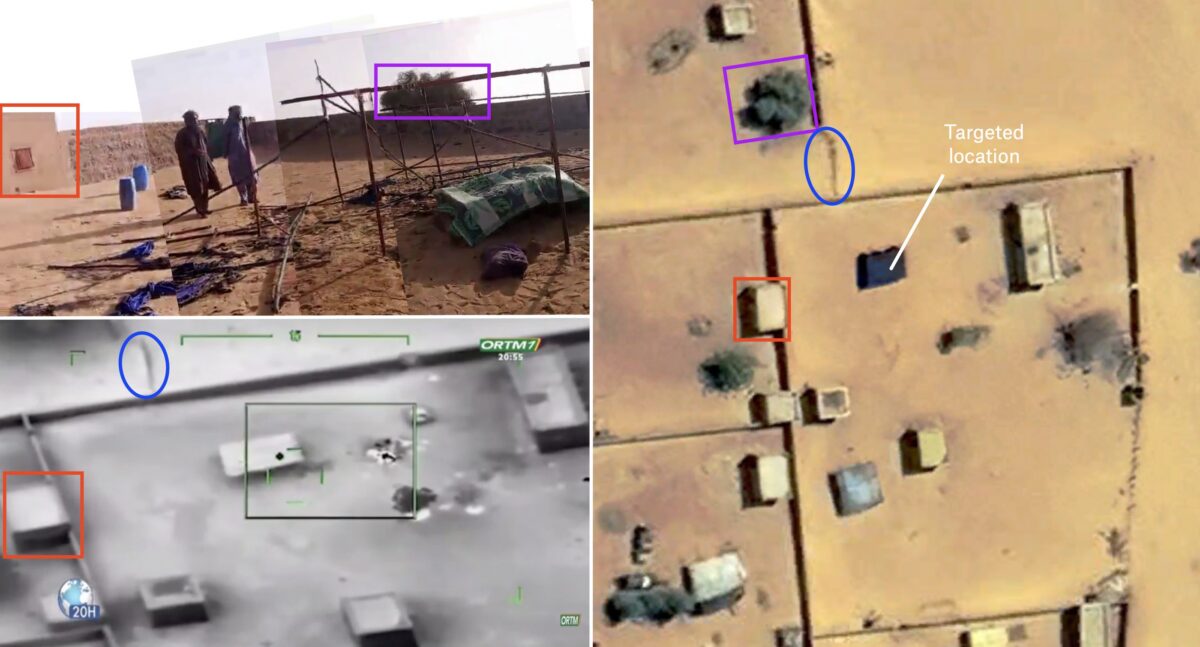
The footage shows an initial strike hitting a parked pick-up truck before cutting to a second strike on a nearby compound, where several people can be seen running moments before impact. The first strike was geolocated to the coordinates 17.08402, 0.76204, by France 24.
Bellingcat geolocated the second strike to a structure within a nearby compound at coordinates 17.081613, 0.768012, where the drone footage shows several people scrambling before impact. Separate graphic footage published by the Spokesperson for the Awazad Liberation Front on X the following day shows several dead people including what appeared to be women lying in and around the compound. France 24’s previous reporting on the strike included images of covered bodies inside a destroyed tent, as well as an image of a child that was reportedly injured during the strike.
Our partner Jeune Afrique obtained testimony from the man who filmed the footage. He said the second strike killed 13 members of two families, including several children, who had gathered in a tent for shelter after the first strike. He added that he helped take eight injured people to health centres. The man told Jeune Afrique he has now joined the separatist FLA group following the attacks.
This testimony would appear to support a 2024 Amnesty International report that stated at least 13 civilians, including seven children, were killed and more than a dozen people injured. Amnesty reported speaking to seven survivors and eyewitnesses who said the first strike hit a Toyota Hilux used by the local health centre. Believing the vehicle had been the target, residents fled to a nearby compound to seek shelter. The second strike then hit the compound directly, the Amnesty report stated.
The FAMa claimed in an official statement just after that attack that: “These operations neutralised several terrorists and destroyed a significant quantity of military equipment and vehicles.” While the pro-Azawad separatist group, the CSP gave a different account, condemning the strikes and claiming that they had killed 13 of which a majority were women and children.
We contacted FAMa to ask whether it maintains that those killed were members of an armed group, whether steps were taken to establish if civilians were present before the strike was carried out and whether an investigation was done into the reports of civilian deaths. We did not receive a reply at time of publication.
Two Strikes in Tinzaouaten
Some of the cases we geolocated had been documented previously. However, we were able to add new details about several strikes. The town of Tinzaouaten near Mali’s northeastern border with Algeria endured two major drone strikes in 2024, reportedly in retaliation for a major assault carried out by separatist and Islamist forces against Malian troops and Russian mercenaries. On July 30, 2024, the Malian military stated it had launched an air campaign around Tinzaouaten in coordination with the military government of Burkina Faso and had targeted “high-value targets”, including caches, logistics hubs and vehicles.
Bellingcat geolocated this footage posted on the day of the strike to 19.92476, 2.98003. The footage shows several damaged structures and what appears to be one casualty.
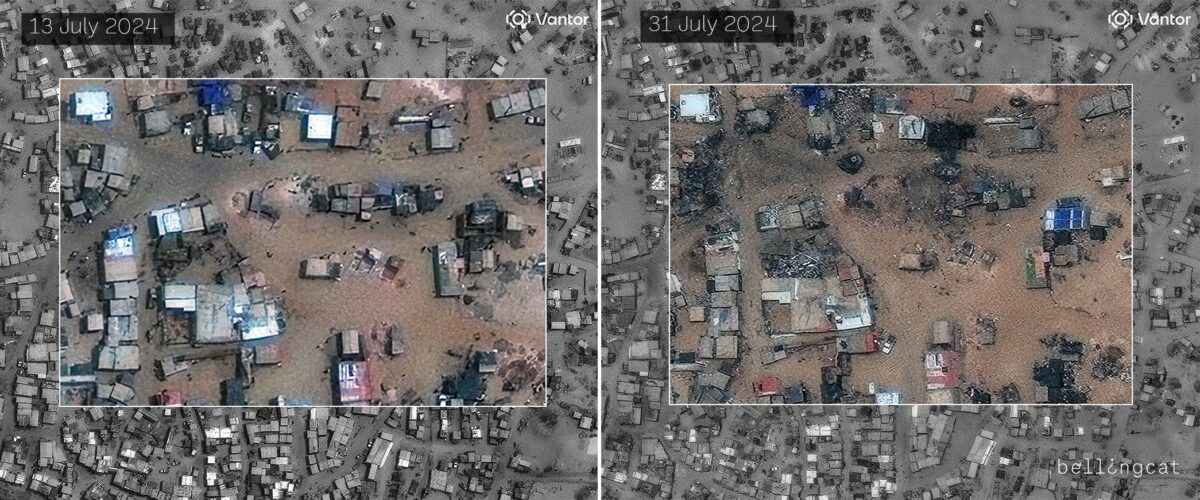
Pits and infrastructure which appear to be consistent with a mine are visible in satellite imagery of the area.
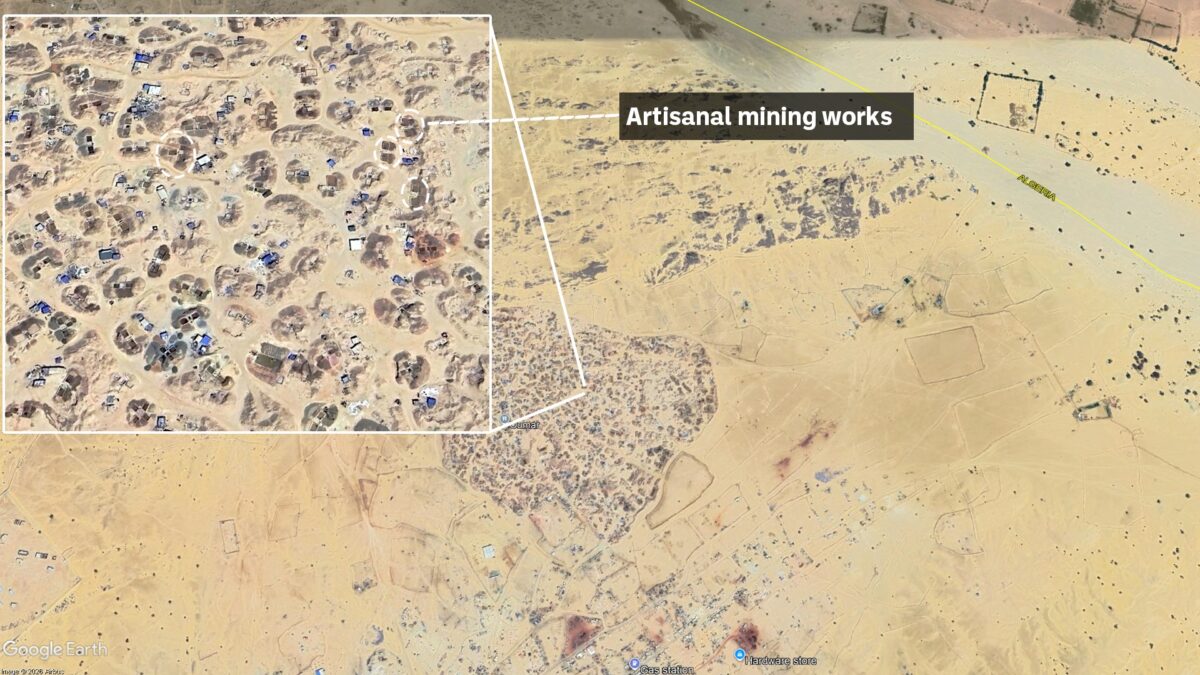
Bellingcat geolocated an additional video posted by a pro-Azawad media outlet showing destruction posted on X to the coordinates 19.92502, 2.98013. In another video geolocated to this site, a man claims he is at the “Inkharaban mine, near the Azawad-Algeria border.”
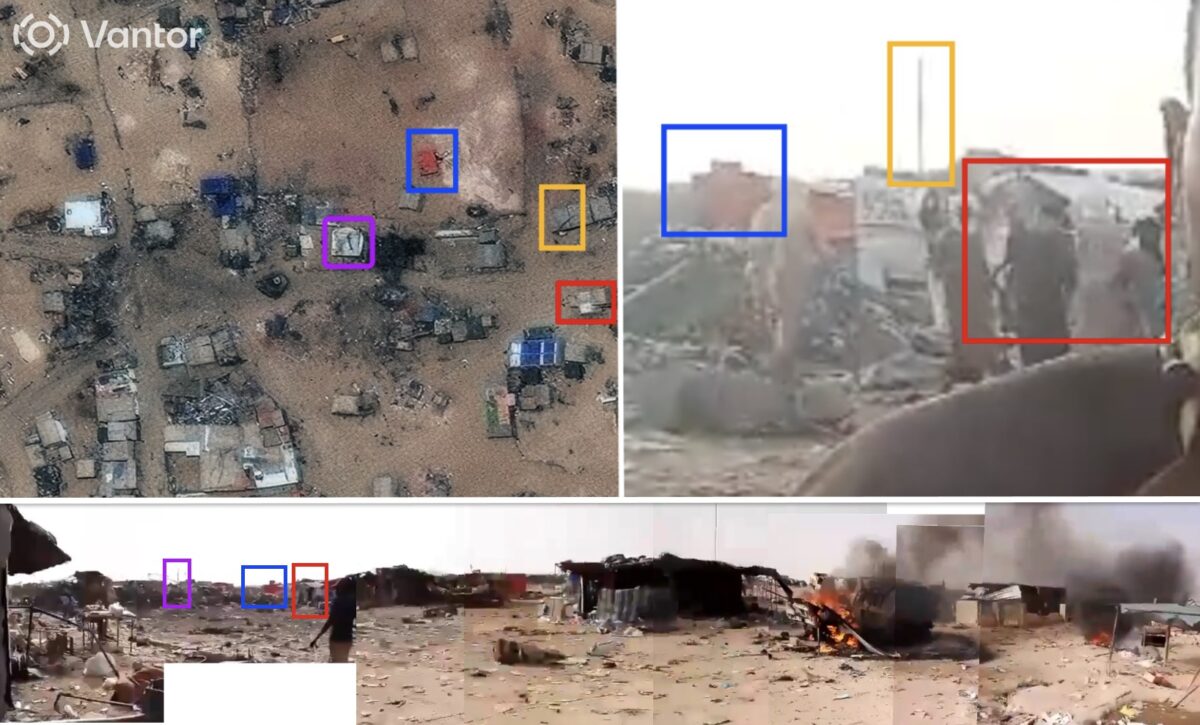
The Second Strike
A month later, on August 25, 2024, FAMa stated it had identified pickup trucks carrying military equipment in Tinzaouaten. It said that, “After careful surveillance, a series of strikes destroyed these terrorist targets and neutralized around twenty armed individuals.” On news channel ORTM1 the newsreader described the operation as “precision strikes targeting terrorist objectives”.
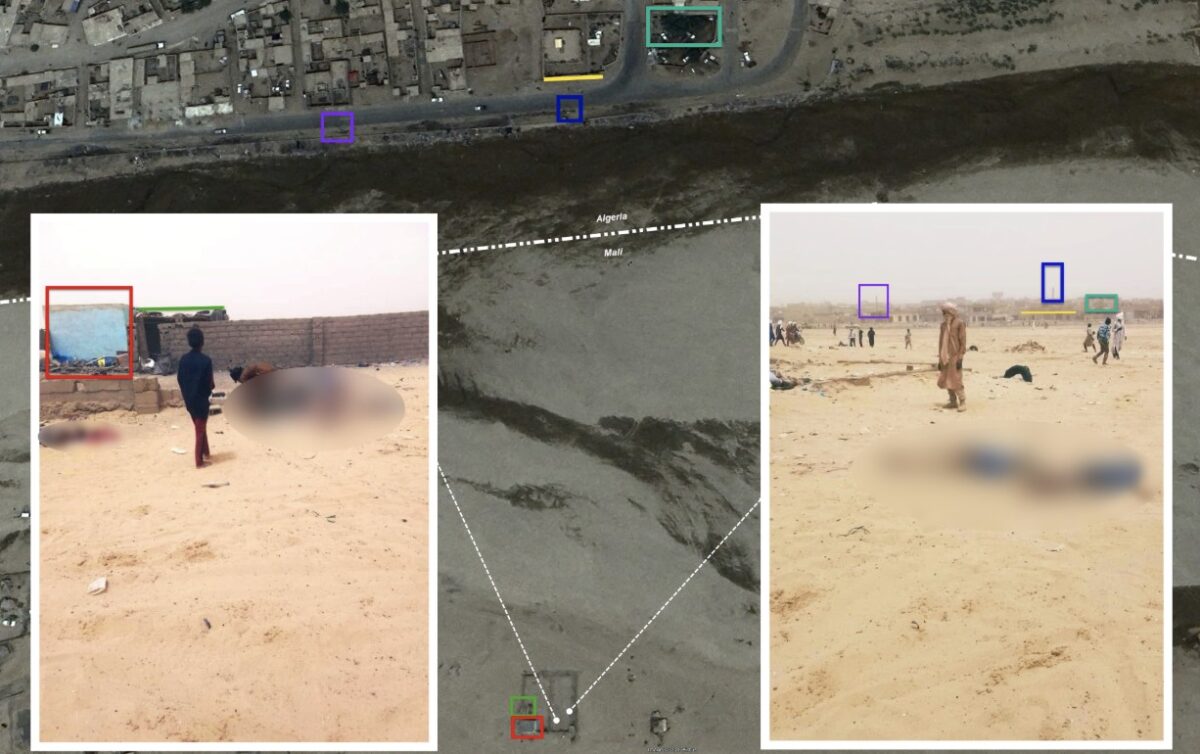
Bellingcat geolocated footage shared online by the pro-separatist Press and Media Agency of Azawad showing the destruction at the coordinates 19.95107, 2.97284, in Tinzaouaten.
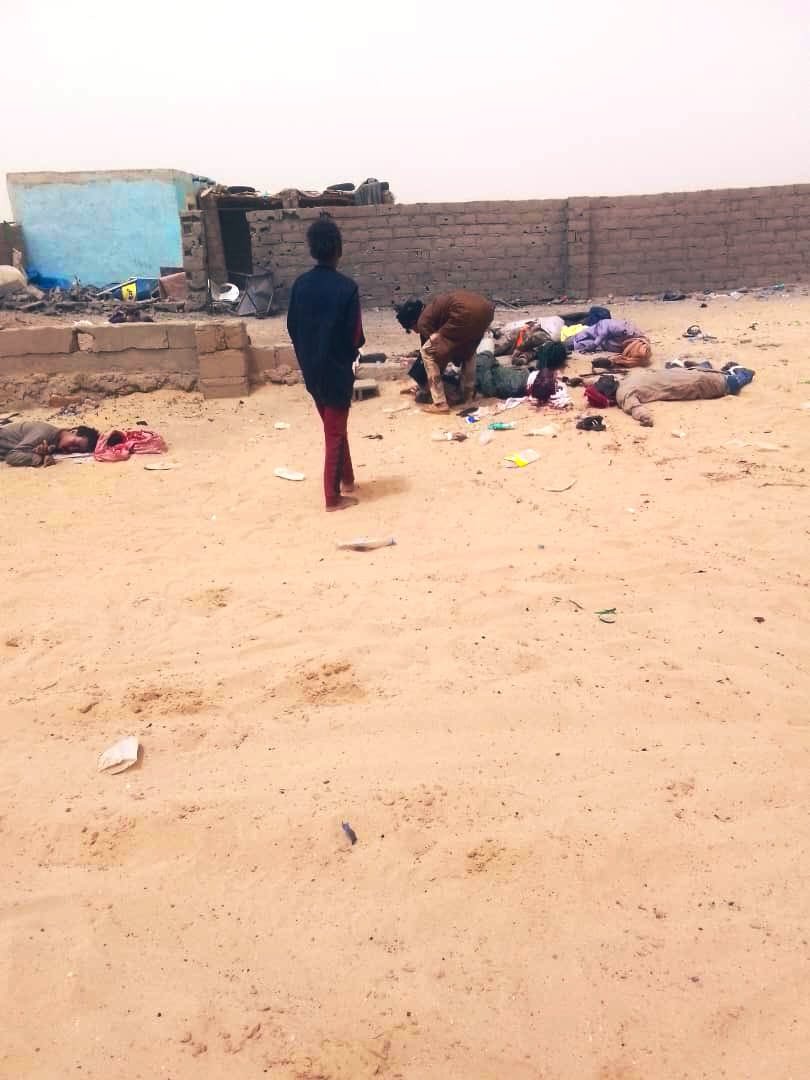
Bellingcat also geolocated two images showing casualties at this location. One image shows a group of around eight bodies, while another graphic image shows the bodies of two young boys around 20-meters away (19.9512, 2.97307). We could not confirm whether or not those pictured were civilians though a resident told Reuters that civilians were killed in drone strikes on the town.
Bellingcat contacted FAMa to ask about the two strikes in Tinzaouten in the summer of 2024. We asked the military what steps were taken to establish whether civilians were present when the strikes were carried out and whether any investigation has been carried out into the two strikes, but we had not received a response at time of publication.
In addition to the above incidents Bellingcat geolocated additional drone strikes based on footage broadcast on ORTM and added them to the below map. We were not able to confirm who was killed in the additional strikes but evidence we analysed show strikes often taking place within populated villages or against vehicles and fuel supplies.
An Expanding Drone Arsenal
Mali has now acquired Turkish-made Bayraktar Akıncı drones, giving its armed forces a longer-range strike capability and the ability to carry heavier munitions than the TB2. This is particularly significant in Mali’s far north, where rebel-held areas can lie beyond the range of TB2s stationed at Malian bases. The Sentry, an investigative and policy organisation, reported the deal for Akıncı drones cost the Malian government $210 million.
In July 2026, Bellingcat documented the use of Shahed-136-type one-way attack drones in northern Mali, likely brought in by Russia’s Africa Corps. Unlike the TB2 and Akıncı, these are one-way kamikaze drones, allowing them to travel farther and carry larger warheads. Experts also previously told Bellingcat that these drones also cannot verify their targets during flight, making them less precise than the TB2, raising the possibility of significant harm if used in populated areas.
Organisations including Human Rights Watch (HRW) and Amnesty International have documented a number of allegations of civilian harm resulting from some Malian drone strikes, relying primarily on testimony from survivors and local communities. Yet many reported strikes have never been independently investigated. Restrictions on reporting, limited access to affected communities and the pace of Mali’s drone campaign have made scrutiny difficult.
Guilt by Location
Julien Antouly, Senior Lecturer in Public Law at the University of Rouen and University of Paris Nanterre told Bellingcat: “There seems to be a recurring pattern in which individuals are treated as military targets because of their location, because of their involvement in certain activities (such as transporting fuel or involvement in mining), or even because of their profile (for example, groups of young men). However, these elements are not, by themselves, sufficient to establish that a person is a lawful target under international humanitarian law.” He highlighted that the Malian military was obliged to follow principles of distinction, proportionality and precaution when carrying out drone strikes.
Professor Luke Moffett, chair of Human Rights and International Humanitarian Law at Queen’s University Belfast said fuel sellers remain civilians even if they may be supplying rebels. Supplying fuel alone does not amount to directly participating in hostilities, meaning they retain civilian protection. If they were targeted for supplying fuel, he said, the strikes could therefore constitute intentional attacks against civilians and potentially war crimes.
Yvan Guichaoua, a Senior Researcher at the Bonn International Centre for Conflict Studies, who focuses on the Sahel, told Bellingcat that the problem may also lie in how the Malian authorities define the enemy. “What we have seen is a huge expansion in the way the Malian authorities define who is considered a legitimate target.”
In northern Mali, armed groups and civilians often use the same roads, vehicles and markets, meaning traders, miners and transporters can be present without being combatants.
Guichaoua describes this dynamic as “guilt by location”, a concept developed by Adam Lichtenheld, an Assistant Professor of Peace Studies, Conflict Resolution, and International Relations at Leiden University, in which a person’s location or activity becomes evidence of an association with an armed group. The Malian authorities have not publicly disclosed their rules of engagement or detailed how individual targets are selected and verified. Without greater transparency, Guichaoua said, the decision-making process remains a “black box.”
Bellingcat’s Youri van der Weide, Miguel Ramalho and Charley Maher contributed to this report as well as the following members of Bellingcat’s Volunteer Community: Ziyu Wan, Afton Briones, Emma Mahon Decker, Nicole Kiess and Riccardo Giannardi.
Bellingcat is a non-profit and the ability to carry out our work is dependent on the kind support of individual donors. If you would like to support our work, you can do so here. You can also subscribe to our Newsletter and follow us on Bluesky here, Instagram here, Reddit here and YouTube here.
 Sebastian Vandermeersch
Sebastian is a researcher at Bellingcat, specialising in terrorism and civilian harm in conflict. He has investigated violence and human rights abuses in the Middle East and West Africa. He previously worked at BBC Verify, the Centre for Information Resilience, and the International Criminal Court.
 Conflict and Human Rights Team
We use open source investigative methods to identify, document and expose human rights abuses as well as to record and explain developments in ongoing conflicts.